Yesterday, I was trawling iTunes for a decent podcast about writing. After a while, I gave up, because 90% of them talked incessantly about “self-discipline,” “making writing a habit,” “getting your butt in the chair,” “getting yourself to write.” To me, that’s six flavors of fucked up.
Okay, yes—I see why we might want to “make writing a habit.” If we want to finish anything, we’ll have to write at least semi-regularly. In practical terms, I get it.
But maybe before we force our butts into chairs, we should ask why it’s so hard to “get” ourselves to write. We aren’t deranged; our brains say “I don’t want to do this” for a reason. We should take that reason seriously.
Most of us resist writing because it hurts and it’s hard. Well, you say, writing isn’t supposed to be easy—but there’s hard, and then there’s hard. For many of us, sitting down to write feels like being asked to solve a problem that is both urgent and unsolvable—“I have to, but it’s impossible, but I have to, but it’s impossible.” It feels fucking awful, so naturally we avoid it.
We can’t “make writing a habit,” then, until we make it less painful. Something we don’t just “get” ourselves to do.
The “make writing a habit” people are trying to do that, in their way. If you do something regularly, the theory goes, you stop dreading it with such special intensity because it just becomes a thing you do. But my god, if you’re still in that “dreading it” phase and someone tells you to “make writing a habit,” that sounds horrible.
So many of us already dismiss our own pain constantly. If we turn writing into another occasion for mute suffering, for numb and joyless endurance, we 1) will not write more, and 2) should not write more, because we should not intentionally hurt ourselves.
Seriously. If you want to write more, don’t ask, “how can I make myself write?” Ask, “why is writing so painful for me and how can I ease that pain?” Show some compassion for yourself. Forgive yourself for not being the person you wish you were and treat the person you are with some basic decency. Give yourself a fucking break for avoiding a thing that makes you feel awful.
Here’s what stops more people from writing than anything else: shame. That creeping, nagging sense of ‘should be,’ ‘should have been,’ and ‘if only I had…’ Shame lives in the body, it clenches our muscles when we sit at the keyboard, takes up valuable mental space with useless, repetitive conversations. Shame, and the resulting paralysis, are what happen when the whole world drills into you that you should be writing every day and you’re not.
The antidote, he says, is to treat yourself kindly:
For me, writing always begins with self-forgiveness. I don’t sit down and rush headlong into the blank page. I make coffee. I put on a song I like. I drink the coffee, listen to the song. I don’t write. Beginning with forgiveness revolutionizes the writing process, returns its being to a journey of creativity rather than an exercise in self-flagellation. I forgive myself for not sitting down to write sooner, for taking yesterday off, for living my life. That shame? I release it. My body unclenches; a new lightness takes over once that burden has floated off. There is room, now, for story, idea, life.
Writing has the potential to bring us so much joy. Why else would we wantto do it? But first we’ve got to unlearn the pain and dread and anxiety and shame attached to writing—not just so we can write more, but for our own sakes! Forget “making writing a habit”—how about “being less miserable”? That’s a worthy goal too!
Luckily, there are ways to do this. But before I get into them, please absorb this lesson: if you want to write, start by valuing your own well-being. Start by forgiving yourself. And listen to yourself when something hurts.
“Authors retain all rights to works posted on BetaBooks, and can add or remove content at their discretion. BetaBooks makes no claim to any of the work posted on the site.”
“Were you in love, Lyanna?” you tearfully ask over a baby’s cries, holding my cold hand. “Were you in love, sister? Tell me the rivers ran red for love. Give me that much.”
I did not love Rhaegar.
I did not love him when his long fingers plucked out the notes of a sad song, his silver voice singing a bride’s tears on her wedding day. I wept, because the girl in the song – she was me.
I did not love him when he leaned over from the saddle with a wreath of winter roses. They were my favorite flower; at least, they used to be, before his metal gauntlet caught in my tangled curls as he queened me. He pulled out a lock of my hair when he drew away impatiently. I should have seen he wanted a piece of me, even then. In the silence, with every face turned toward me, I was the only one who could hear the princess screaming, hoarse screams. I dropped my eyes. I did not know when I would be able to raise them again.
I did not love Rhaegar, not even as he held out his hand in the hour of the wolf. “Come with me. I can take you away.” I hesitantly agreed. I was no stranger to horses, and the prince and his Kingsquard knights had plenty to spare, but he insisted I climb up in front him – another warning I missed. I could barely breathe, he held me so tightly, but the wind was in my hair and at last I was outracing everyone.
I did not love him when the fingers that knew my song suddenly sought notes to play on my bare skin, with no care for harmony. Just because I looked a woman did not mean I knew what women know. I was not yet sixteen.
I screamed at him when word came of our brother and father. Burned. Strangled. I understood how Princess Elia must have felt, screaming for so long with no one listening. I screamed as he kissed my swelling belly and rode away without a word, like I was nothing more than eggshell. Made to be broken and discarded, no matter how beautiful.
I whispered to the baby moving in my belly, quietly, so Rhaegar’s knights wouldn’t hear. I told him to be headstrong like Brandon, to be true like Benjen, to be noble like you. He learned nothing of his father, not from me.
I screamed in my bed of blood. I hated him by the time I heard your sword singing to me, singing sweeter than Rhaegar ever sang. I screamed at the pain, screamed in triumph. I was alive and he dead.
I screamed too soon.
“Promise me. Promise me he will know nothing of his father. Keep him safe. Promise me, Ned.”
“Were you in love, Lyanna?” you tearfully ask over a baby’s cries, holding my cold hand. “Were you in love, sister? Tell me the rivers ran red for love. Give me that much.”
I was, dearest Ned. I was.
I was in love with having a choice. Rhaegar opened my cage, and said I could run free, if only I chose to. He said a direwolf was no pet, and I agreed.
It wasn’t my fault I was deceived. I was not yet sixteen.
If you signed up to give feedback on a manuscript, be prepared to do two things:
1. For every opinion you give, explain why.
What lead you to the conclusion you reached? If you don’t know this, you may need to reread a few times until you figure it out.
2. For every specific situation, concept, or relationship the writer asks about, describe your interpretation back to them.
Give a short summary, whether its of what you believe happened, or how you think that piece of world building works, or why you believe those characters came to that conclusion, or why the PoV character is feeling these emotions.
Often problems appearing toward the end of a manuscript are caused by misunderstandings in earlier segments. If you tell the writer your interpretation of the key events as you go, they can identity the root of those problems much easier.
Negative Critique: Courtesy Is Key.
Unless you are either (a) a professional editor who’s being paid to whip the manuscript into shape or (b) a long time critique partner with a strong relationship with the author, always be as kind and gentle with negative critique as you can. If a writer trusts you enough to let you look at something they poured their soul into, it’s your responsibility to be honest but also courteous.
Try to avoid:
Sarcasm; “Like that would ever happen.”
Absolutes; “This would NEVER happen.”
Abruptness; “Bad. Change.”
Arrogance; “This wouldn’t happen. [My way] would. Do it instead.”
Better ways to approach negative critique:
Make it clear that you understand the problem might not be in the writer’s ideas, but your interpretation of them. Don’t harp on a writer’s creativity– guide them towards explaining their awesome concepts better!
Respect the time and effort that’s already gone into the writing by demonstrating that this work as valuable, even if major changes are still needed. Example: ”You have a lot of great concepts here, like [this and this], but I think they would hit home a lot harder if you rewrote the chapter [like this], while still including [the good aspects of the current chapter].”
Your personal writing style is unique to you. Pick out incidences of passive voice, filter words, and bulky or awkward sentences, but don’t try to rewrite sentences to fit your personal preferences unless you’ve already talked it over with the writer in length.
All your critiques are only your opinion, and they aren’t necessarily the same opinions of this writer’s future publisher. Mention when a writer’s use or breakage of a “writing rule” throws you off, but don’t claim your preferred way is the correct way.
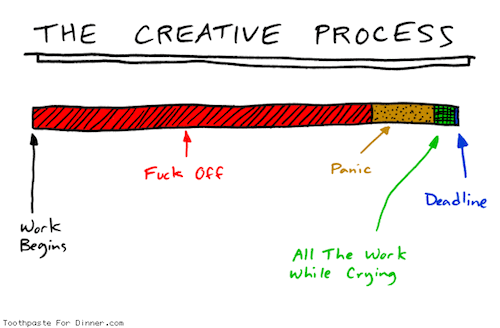
This is the best explanation I could come up with for why it takes me so long to do updates sometimes when, at other times, I’m typing them up like clockwork.
There are two things that really do stand out when Americans write fics set in Europe. One is the guns everywhere and two is having a driver’s licence and a car before people are 18.
Guns is a big no no in Europe. Even if you theoretically could own a gun, very few people who doesn’t live on the countryside and are regular hunters own guns. And it’s not something you can acquire just like that either. Most European countries have reasonably strict gun laws which means you need to have taken a course in how to use one and pass a test, plus you can’t have any run-ins with the law or you’ll not even be allowed to shoot with a gun club with a loaned weapon, let alone own one. Guns are to be stored in weapon safes, and on breech-loading guns the bolt must be removed. The idea is that it’s supposed to be difficult to just grab a weapon and shoot. Guns is a rarity and those waved around on the streets are all in the possession of criminals. Not even they have a multitude of weapons, because despite what alt right people says, it’s not that easy to get hold of a weapon illegally and they are often handed around between people which is why the police can tie gang shootings and murders to each other since it’s usually the same weapon involved in several shootings. If they catch one weapon and the person having it, the chances are that several shootings are cleared up at the same time. Now, these laws extend to several other objects used as weapons too. Tasers aren’t allowed. Many countries have laws about knives too. If I carry a knife at work because it’s part of my arsenal of tools, it won’t be a problem, but if I walk around with one in my pocket when out on town, that’s an offence.
In theory you can get your driver’s licence and car at 18, but, again, unless you live on the countryside, most will get neither a licence nor a car that early. Cars are expensive to buy. Insurance is expensive. Taxes are high. Fuel makes your bank account fucking bleed. Unless you really have a well paying job and really need it, it’s not an expense you want. Besides, it’s pretty costly to get a driver’s license, so if your parents can’t shoulder the cost, it will take a while before you can get it yourself. If you live in an urban area you don’t really need a car either because public transport is pretty good. There are busses, trains, metro and in many cities using a bike (in the south a Vespa is the preferred alternative) is by far the fastest and best way to get around. European cities aren’t built for car traffic and it’s not only a nuisance with the clogged streets but also the ever lasting headache of finding a spot to park. Parking is NEVER free. Plus congestion charges is a thing, from city centres to motorways. In London, Milan and Stockholm you pay a toll for entering the city, for instance. All of this means that young people under 25 practically never owns cars, even if they might have a driver’s licence which you can’t bet on. It’s really not until people get married, has kids and buys a house in suburbia that they get a car. These days car sharing is becoming a thing in bigger cities too, from municipality initiatives to car companies like Volvo setting them up, meant for families with kids. For municipalities it’s a way of reducing traffic and for car companies it’s a way of staying in some sort of market even when fewer and fewer people buys cars.
In short, Europeans don’t have the same relationships to guns and cars as Americans have.
My biggest pet-peeves with Americans writing about Europeans, although this may just be specific to the United Kingdom:
You don’t need to tip any service staff
Post/Mail comes through a slot in your door; mail-boxes may exist attached to the building, but never as a separate box at the end of the garden/driveway … mailboxes don’t exist
No one has air-conditioning – only shops/stores have air-conditioning units, and even these are only for customer benefits and not in back
Here’s to the fanfic writers who can only write sporadically.
Here’s the writers who can’t output enough to keep up with the most popular writers.
Here’s to the writers writing even though they get no feedback.
Here’s to the writers who somehow manage to scrape together a little inspiration and a lot of hard work to write that story they know nearly no one will read.
Here’s to the creators who keep going even when it’ feels like screaming into an empty void.
You’re inspiration, and I don’t know how you do it.




 Stressed, Depressed, and Story Obsessed