So I’ve been doing lots of D&D world-building lately and I’ve kind of been putting together lists of words to help inspire new fantasy place names. I figured I’d share. These are helpful for naming towns, regions, landforms, roads, shops, and they’re also probably useful for coming up with surnames. This is LONG. There’s plenty more under the cut including a huge list of “fantasy sounding” word-parts. Enjoy!
Towns & Kingdoms
town, borough, city, hamlet, parish, township, village, villa, domain
kingdom, empire, nation, country, county, city-state, state,
province, dominion
Island,
isle, peninsula, isthmus, bight, headland, promontory, cape, pointe,
cape
More under the cut including: Color words, Animal/Monster related words, Rocks/Metals/Gems list, Foliage, People groups/types, Weather/Environment/ Elemental words, Man-made Items, Body Parts, Mechanical sounding words, a huge list of both pleasant and unpleasant Atmospheric Descriptors, and a huge list of Fantasy Word-parts.
A conversation I got into with some of my friends turned into specific character design thoughts, and something I think is a big rule is:
Anything you put in your character’s design is a prop for them to express themselves.
Characters need to tell the audience about themselves, and I think one of the best ways to do that is often using habits, tics, body languages, just what they do with themselves. Smiling when happy is a very generalized and universal sort of trait, but if a character has, say, a distinctive overbite and tends to smile crookedly, or only ever smiles the tiniest amount so if they weren’t wearing very striking lipstick you would never catch those movements- that becomes far more distinctive. Those sort of descriptions actively conjure an impression of a character.
Clothing is a prop. Accessories are props. The things your character wears and surrounds themselves with will speak volumes about their routine, their life, their interests, their priorities.
And they’re fantastic for exaggerating or calling attention to character quirks. Have a character who fidgets with things? Give them a lot of necklaces or bracelets or a favorite ring. Character who makes a lot of gestures with their hands? Think of gloves, rings, nail polish- whatever makes sense that will draw the eye to that part of their body.
You can get even more fun giving characters contradictory traits they’re navigating with varying levels of grace- for example, someone with fancy painted nails that have rough, bitten edges because they’re trying to stop chewing them but aren’t quite succeeding yet, or a fashion-conscious type who loves heels but is also a track-and-field star so all their shoes have low sides they can easily kick off and hit the ground running.
If you have a character that shoves their hands in their pockets often, give them noteworthy pockets. Maybe they keep things in there? Kinda hard to get your sulk on when you put your hands on that granola bar you forgot you took with you so now you have to sulk around your newly-discovered snack.
Alright so if you’re a writer then you’ve probably familiarized yourself with plot…and the structure it provides to a novel. There are countless articles online on “how to plot a novel” or the like. Which is fantastic for you writers because it’s at a fingers reach from us. Not so great when there’s about…a billion ways one can go about plotting a novel. It can seem daunting and overwhelming and more important confusing!
I want to break down this massive task bit by bit. Starting with the very bare bones and working into more detailed parts. Making it more manageable.
Now, I know some of you might roll your eyes and say I know all there is to know about plot. I was you. I went into every workshop and craft class thinking the same thing. And yet, when I started plotting my recent WIP ( The Cost of Defeat ) I realized I didn’t know jack. I thought every story I ever wrote would adhere to my system of structure because of sheer will and blunt force. Yeah wrong.
It wasn’t until just recently I started diving into the structure ( because I like pretty diagrams and being organized way more than I should) that I discovered there are a lot of different Plot Structures out there. No one bothered to ever teach me let alone discuss these things. My mind was blown.
Some worked better for me than others. Some mesh better together than others. It’s all about experimenting and figuring out what works for you. And I’m hoping that this will also help others, or at least give a jumping off point. Now it’s not a whole list ( there’s a lot of elements that I could probably talk about by themselves) but it’s a good overview of the popular ones that reoccur a lot.
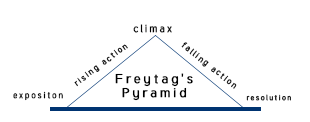
1) Freytag’s Pyramid
Freytag’s pyramid is the most basic plot structure I know. It’s the one we’ve all seen in school when we start learning about story structure and analysis.
This bad boy is the simplest plot structure used to dissect and understand Greek and Shakespearean Plays.
Pros x Simplistic. Makes it easy to understand x Great for those just starting ( or those who want to understand film and literature analysis. x Great for AP Literature/Comp papers
Cons x It creates simple stories x Not super awesome for modern novels or anything longer than about 25K words
Uses x Children’s Literature. Picture books mostly. Children are still learning to understand things like conflict effect on characters and having such a long falling action allows for that. x Short Stories. Since short stories are compact for punch, this structure allows you to get the most done without boring the reader in 25K words or less. x Analysis. This structure is the easiest and most common to apply to plays, film, tv and even in classic literature. It’s a great way to dissect plot and events in order to better understand the pieces working parts
Examples: Shakespeare’s Hamlet and Romeo and Juliet Sophocles’s Antigone Henrik Ibsen A Doll House
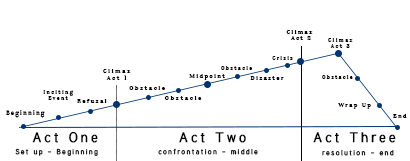
2) Three-Act Structure
The Three-Act Structure is probably the most known. We all know this intuitively as storytellers. Everything needs a beginning middle and end, after all.
This structure is very similar to Freytag’s Pyramid but adds elements that beef up and create points of interest. Obstacles, for example, add conflict and build up suspense for the climax. It’s also important to note that the falling action and resolution is much more compact.
Pros x basic building block for all good stories x Roadmap-like so you can be systematic about things x Good “big-picture” visual
Cons x Pacing is super important for this x Bit rigid and formulaic
Uses x Literally anything. Because it’s versatile it works on a plethera of stuff, let your imagineation run wild. x Film analysis. This struccture is like the holy grail in almost any film class ( sometimes they call it the four act structure)
Examples: Sir Arthur Conan Doyle Sherlock Holmes Alfred Hitchcock’s Vertigo Jane Austin’s Pride and Prejudice
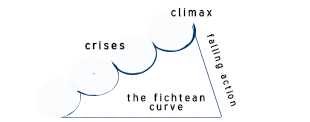
3) The Fichtean Curve
The Fichten Curve Is really unique in that it starts right with the rising action. There ain’t no time to build up or nice slow introductions, you’re dumping the readers right where it hurts. But you make up that lost time with the small bits of exposition
This is one of the most popular plot structures for modern novels.
Pros x A lot of opportunities to ramp up the stakes, bit after bit x Good for pacing x Great for Overcoming Monster & Quest stories x Translate over almost any genre
Cons x Not a lot of time to slow down, breathe x Not suited for Voyage and Return, Comedy or Rebirth stories
Uses x Thrillers/Mystery novels. You need something to keep readers in the story, chomping at the bit. here’s the plot structure for you.
Examples: Max Brooks’s World War Z
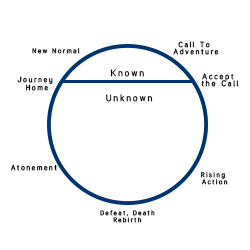
4) Plot Embryo/Hero’s Journey
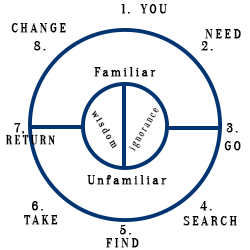
The Hero’s Journey is also super common in the literature (namely western literature) With this plot the protagonist ( the hero of hero’s journey) undergoes a literal or figurative death-like transformation that changes him.
The protagonist must venture from one state into another. To take it a step further there’s a variation called the Ploy Embyro. Dan Harmon takes the hero’s journey a bit deeper and modernizes. [ here’a great video on it by youtuber Rachel Stephen x]
As you can see, the Hero’s Journey and Ploy Embyro are both cyclical. This baby comes full circle in both plot and character. They have similar plot points. But if I were to gush about this the post would be waaay longer than it already is. This is one of my preferred methods because it just makes sense for me and allows me to have some freedom and wiggle room while still adhering to the 3 acts.
Pros x Character development holla, cause this is where it’s at. x Visually appealing x Simple 8 point outline ( for those who might not enjoy long-winded outlines) x Works alongside A beat sheet ( if you use that sort of thing) x The holy grail for myths.
Cons x Overdone ( but it doesn’t have to be a bad thing) x Not suited for those who really detailed outlines
Uses x Adventure Stories. It is all about the adventure and journey with this x Myth Retellings. I mean it’s based on the myth structure of the Odyssey and the like so it makes sense
Examples: Harper Lee’s To Kill a Mockingbird Rick Riordan’s The Lightning Thief J. R R. Tolktien’s The Hobbit
5) In Media Res
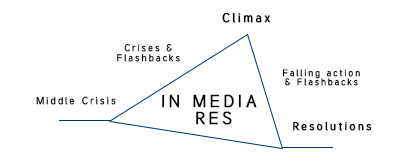
A literal translation to “In the Middle”. This plot structure dumps you right in the middle of the story. Think if you were to open a story on the second of third crisis/pinch point. there’s still a lot of upward trajectory to go before the climax.
Don’t confuse this with simply opening a story mid fight/action. Media Res starts well deep into the story itself, close to the climax but with enough room you can still build up to it.
Pros x High Actions x Simple and fun to play with x A good use for flashbacks x Hell of a hook for readers
Cons x Can be confusing for reader’s if not done right x No build up x takes some finessing to get just right
Uses x Mysteries. This is a great plot if you want to start a story perhaps where the killer has already committed the murder. x Epic Poems. Maybe you wanna write the next epic poem, this is great for that.
Examples John Milton’s Paradise Lost Homer’s Illiad George Lucas’s Star Wars
Now I could go on and on but this monster of a post has carried on long enough. If there’s a certain structure you’d like me to go into more detail about feel free to leave a comment on this post and I’ll be sure to add it to my line up!! As always happy writing/creating!
There are two things that really do stand out when Americans write fics set in Europe. One is the guns everywhere and two is having a driver’s licence and a car before people are 18.
Guns is a big no no in Europe. Even if you theoretically could own a gun, very few people who doesn’t live on the countryside and are regular hunters own guns. And it’s not something you can acquire just like that either. Most European countries have reasonably strict gun laws which means you need to have taken a course in how to use one and pass a test, plus you can’t have any run-ins with the law or you’ll not even be allowed to shoot with a gun club with a loaned weapon, let alone own one. Guns are to be stored in weapon safes, and on breech-loading guns the bolt must be removed. The idea is that it’s supposed to be difficult to just grab a weapon and shoot. Guns is a rarity and those waved around on the streets are all in the possession of criminals. Not even they have a multitude of weapons, because despite what alt right people says, it’s not that easy to get hold of a weapon illegally and they are often handed around between people which is why the police can tie gang shootings and murders to each other since it’s usually the same weapon involved in several shootings. If they catch one weapon and the person having it, the chances are that several shootings are cleared up at the same time. Now, these laws extend to several other objects used as weapons too. Tasers aren’t allowed. Many countries have laws about knives too. If I carry a knife at work because it’s part of my arsenal of tools, it won’t be a problem, but if I walk around with one in my pocket when out on town, that’s an offence.
In theory you can get your driver’s licence and car at 18, but, again, unless you live on the countryside, most will get neither a licence nor a car that early. Cars are expensive to buy. Insurance is expensive. Taxes are high. Fuel makes your bank account fucking bleed. Unless you really have a well paying job and really need it, it’s not an expense you want. Besides, it’s pretty costly to get a driver’s license, so if your parents can’t shoulder the cost, it will take a while before you can get it yourself. If you live in an urban area you don’t really need a car either because public transport is pretty good. There are busses, trains, metro and in many cities using a bike (in the south a Vespa is the preferred alternative) is by far the fastest and best way to get around. European cities aren’t built for car traffic and it’s not only a nuisance with the clogged streets but also the ever lasting headache of finding a spot to park. Parking is NEVER free. Plus congestion charges is a thing, from city centres to motorways. In London, Milan and Stockholm you pay a toll for entering the city, for instance. All of this means that young people under 25 practically never owns cars, even if they might have a driver’s licence which you can’t bet on. It’s really not until people get married, has kids and buys a house in suburbia that they get a car. These days car sharing is becoming a thing in bigger cities too, from municipality initiatives to car companies like Volvo setting them up, meant for families with kids. For municipalities it’s a way of reducing traffic and for car companies it’s a way of staying in some sort of market even when fewer and fewer people buys cars.
In short, Europeans don’t have the same relationships to guns and cars as Americans have.
My biggest pet-peeves with Americans writing about Europeans, although this may just be specific to the United Kingdom:
You don’t need to tip any service staff
Post/Mail comes through a slot in your door; mail-boxes may exist attached to the building, but never as a separate box at the end of the garden/driveway … mailboxes don’t exist
No one has air-conditioning – only shops/stores have air-conditioning units, and even these are only for customer benefits and not in back
“If you’re writing about a gay boy or a black girl, you need to talk to a gay boy or black girl. You have to go above and beyond to get it right. The internet is a beautiful thing for a writer, but we have to put in the work. I think that’s key: Put in the work. Whether you’re writing about diversity or a legal thriller, you have to put in the work. Find the resources. Find the people. And when you find the people, please pay them. No one owes you anything — you owe them for their help!”




 Stressed, Depressed, and Story Obsessed