a character’s favorite vehicle, technology, coat, etc.
a pleasant night
hair, skin tone, clothing, etc. of a good person
undisturbed water of a lake
the case/container of something important
valued wood, furniture, art
velvet
Think to burn, to infect, to bleach vs. to enrich, to protect, to be of substance.
*slams reblog like the fist of an angry god*
the politics of light and dark are everywhere in our vocabulary…psa to writers: subvert this, reveal whiteness and lightness as sometimes artificial and violent, and darkness as healing, the unknown as natural
“The truth finds more comfort in the dark”
“The light can blind as easily as the dark conceals. The dark can protect as easily as the light guides. Neither are pure good nor evil, pure chaos nor order. The light and dark just are.”
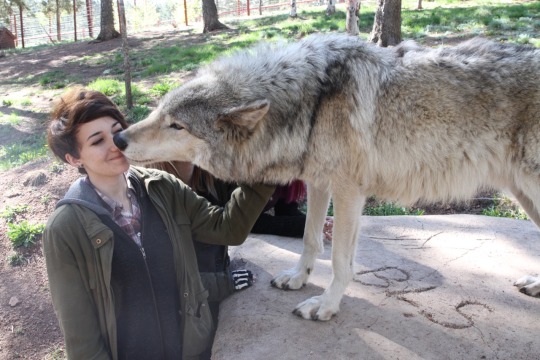
if youve never physically been in the presence of like, a real live wolf, and you probably wont get the chance to, heres some stuff about them you should know
a wolf’s fur is so unbelievably thick that you can get like, your whole hand into it while petting. and then you can keep going
wolves are a lot bigger than you think they are. think about how big you think a wolf is then just like double that
they dont really smell like dog but they DO smell and youre not going to be able to figure out if its a good smell or not
a wolf really wants to lick the inside of your mouth. he will not stop trying to lick the inside of your mouth at any cost, and generally speaking you need to press your lips together kind of tightly when he approaches your face so that he doesnt worm his damn tongue in there to give you what he thinks is an appropriate greeting
a wolf doesnt really want to look at you while you pet him but he wants you to pet him. hes embarrassed
if a grown ass wolf decides to lay down on you, you just have to deal with it and thats your life now
young wolves, much like young dogs, are overwhelmingly goofy and stupid. a teenage wolf will see your very fragile, very human shoulder and go “i can probably step on that with my full weight” and then he will do it
letting a wolf eat out of your hand is actually not remotely frightening, and youll want to do it all day
Realizing it’s not romance that I hate but overdone straight relationships with zero chemistry built on a slew of misogynistic tropes was like a huge revelation for me
I have a story about this.
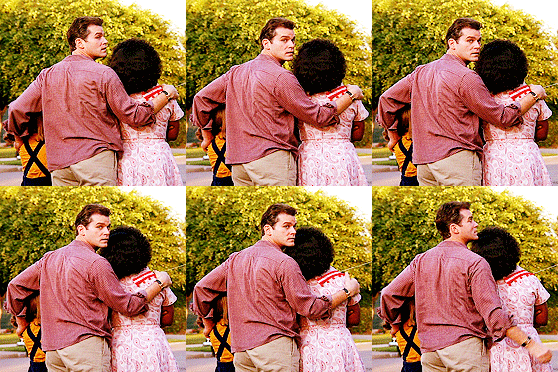
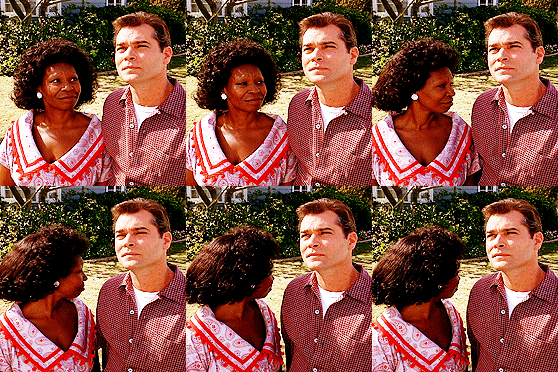
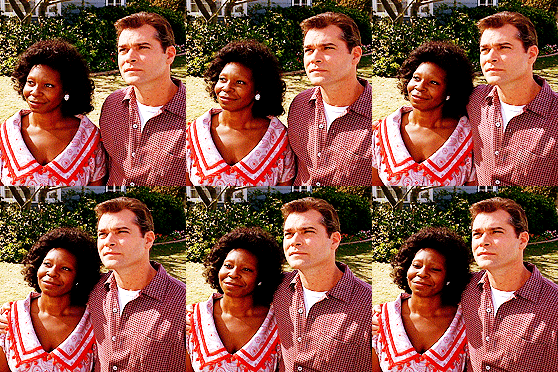
My revelation regarding this was spurred by a little-known film that actually didn’t do very well in theatres at all, from the early 90s called Corina Corina.
Starring heartthrob of the time Ray Liotta, fresh off his Goodfellas fame and…..Whoopie Goldberg??? as his love interest??????
Bear with me here.
Corina Corina is the story about a man whose wife died, leaving him alone to parent his 8-9 year old daughter alone in what appears to be the late 50s-early 60s. His daughter, Molly, is non-verbal due to the trauma of her mother’s death and is dealing with feelings of isolation as a result of her mourning process. Ray Liotta’s character makes a concentrated effort to be a good dad for her, but it’s real clear that both of them are still dealing with the death of his wife. Because Ray’s character works full time, he needs to find a nanny to watch his girl and pick her up from school. After a couple of terrible experiences (one with a hilarious appearance by Joan Cusack) he decides to hire Whoopie Goldberg.
Whoopie Goldberg’s character is a college educated black woman (in the 50s!!!!) who appears to be doing domestic work because its the only work white 50s America will hire her for. She and Ray’s daughter Molly get along well because she is the first person to take Molly’s decision to be non-verbal seriously and learn an alternate way to communicate with her.
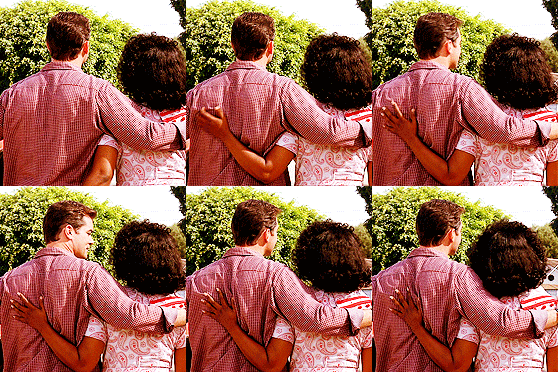
Long story short, Whoopie Goldberg and Ray Liotta fall in love and live happily ever after.
But, more importantly, the way the movie built their love changed the way I was able to process hetero couples on screen forever.
1. First, they were both provided with alternate romance options from the beginning of the movie. Ray was given an extremely attractive white lady love interest, and Whoopie was given an attractive and charming black man love interest. Both of them were given opportunities to return their affection but both pointedly chose not to.
2. They were attracted to each other based on common interest. They both liked the same music, they both bonded over their ability to play the piano, they both loved molly, they both helped encourage each other in their chosen fields (whoopie’s was english, and ray’s was being a songwriter), they both respected each other’s opinions and they both were honest with each other about the circumstances they were in.
3. They were realistic about the issue of a black woman being in a relationship with a white man in the era, and didn’t glide over racial identity issues. Ray made sure that his white neighbors knew that he loved her and didn’t care what they thought. He even explained to his mom that Molly emulating black culture wasn’t shameful and that she should mind her business about the way he felt about Whoopie Goldberg.
4. When Ray confessed his feelings, it was incredibly heartfelt and he was literally crying.
5. They didn’t pursue a romantic relationship until Whoopie wasn’t working for him anymore. And they didn’t gloss over the issue of power disparity in that equation. Ray doesn’t condescend to Whoopie at all through the movie, but once he’s aware he has feelings for her, his new goal is to let her know that he unquestionably considers her his equal both in private and in public And its clear that he’s aware that this is the first thing that must be settled before anything else.
By the time you get to the end of the movie, the entire concept of Ray Liotta being with Whoopie Goldberg seems not only normal, but exceptionally romantic and you’re left wondering why you thought they would be a gross couple to begin with when they’re sO cLeArLy MaDe fOr eAcH oThEr
I now call this the Corina Corina standard.
If a movie has a hetero couple and their relationship isn’t as fleshed out as Ray/Whoopie, I now have difficulty accepting whats occurring.
The concept that two hot straight people who are vaguely near each other just doesn’t do it for me anymore after watching Ray Liotta walk through a black neighborhood in the 50s and knock on Whoopie’s door to beg her to come home to him.
i rarely see more than one (1) disabled person in fiction, and at that i rarely see disabled people that don’t have on sight disabilities. ya know i just wanna see a character or two having type one diabetes, better at that, i wanna see them be in some sort of fantasy fiction.
off topic of this, but i hate the “character with x disability gets disability ‘fixed’ once in fantasy/magical land” trope, like why are people so quick to fix us? why can’t people just make living with disabilities easier in fantasy lands instead of erasing them?
like i’d love to have a tiny pocket dragon that could sense my blood sugar highs or lows, i’d also think it’d be cool that a wizard could give me a potion that lets me eat cake or pizza or pasta without dying.
I think a lot of the time, abled writers are under the impression that they’re doing disabled people a “favour” by providing escapism from what they consider to be awful lives. The thing is though, when you’ve got a disability you tend to be quite good at finding ways around it, and honestly? Can you imagine how wild that would get in a High Fantasy? It’d be fantastic. Consider:
Pocket service-dragons like OP said, trained to monitor vitals and blood sugar. They’re good at helping people with cardiovascular-type problems, epilepsy, diabetes and asthma. All the dragons require in return is permission to hoard pocket lint in caches around the home.
A different, slightly larger breed of dragon will sit on the shoulders of those who are Deaf and/or blind. They’re probably about the size of a crow. These ones act as guides and signed language interpreters, and are able to communicate in more code (or a fantasy equivalent) by tapping with their claws. Plus, they’ll breathe fire at anyone who is being an ableist piece of shit.
Fantasy hearing aids that are part magic, part tech. They mould around the ear in whatever shape the wearer wishes (bonus if they look like serpents or vines with a silver sheen) and, if not being used, can coil around a wrist or finger. (Do you have any idea how many times I’ve almost lost my aids bc they fall out of pockets or get misplaced??)
If the wizarding world of JK Rowling gets wingardium leviosa, then fantasy can totally have magically enchanted supports – walking frames, crutches etc – that come to the person’s aid when needed. Also, levitating charms? Clothing that supports the wearer so that a lower-limb amputee can whisk around places? Just think about Doctor Strange’s magical cape.
And then, after all that, your fantasy world can literally just have the same aids as ours. There are many, many creative options and every single one of them are preferable to being erased from the world of fiction.
*sigh* I’ve already made an addition but this idea is SO under-explored. So please also consider:
The literally limitless possibilities for prosthesis, including having a character stand on their flying prosthetic foot in order to fly/levitate, prosthesis that remains awake while they sleep and can defend them in the night, prosthesis that looks completely real but is just packed with compartments, prosthesis that functions precisely like a real limb and is directed normally by the brain, invisible prosthesis, magnetized steampunk prosthesis, limb prosthesis that is basically a floating hand/foot with the limb between missing- like, can’t be touched missing,
A full menagerie of mythical beasts that can serve as service animals, up to and including keeping the soul in the body while waiting for healers to arrive so that the heart can be re-started much longer after it has stopped beating. Some mythical birds were said to steal nightmares and fly away with them as well.
Horse-sized intelligent dragons used as mobility aids
Chariot/chair/wheelchair mobility aids that levitate and/or move quickly
Emergency communication devices that will alert the other holders of a crisis with location and specifics even when you’re is unconscious, such as with epilepsy or passing out from low blood sugar
Hearing aids/glasses that not only aide impaired hearing/vision, but also allow the user to hear/see in other specified places in the world
Magical devices that stimulate dead nerves in cases where a limb goes dead, reducing the need for amputation
Similar magical devices that straight-up reanimate dead limbs, so that you can leave your arm lying around and still use it when you walk away (so much plot opportunity, SO much)
Magical capsules you can swallow that give you lots of healthy energy, which can be used for various disorders that lead to fatigue but can also be used as a first aide to aide healing of wounds/illness
Pill cases that remember what you need to take and what you’ve actually taken and WILL get in your face if you’ve forgotten
Capsules or spells for cleanliness that reduces the need to bathe for those for whom it’s difficult
House plants that release chemicals your brain SHOULD be producing so that you breathe it in- possibly in conjunction with medication that helps to regulate so you don’t overdose on serotonin what you’re trying to sleep
Plants you can eat that will literally replace your compromised immune system
A ritual that will take a magical 3D photograph of your current physical condition, and, if you’ve taken one, you can use this complicated spell to have your physical body go back and become exactly what it was at that point- like a computer backup.
Many, many options for spells, healing herbs and rituals that will ease chronic pain
I think ya’ll mentioned why abled writers ”fix” disabilities. Magic. Why give you a magical hearing aid when they could just magically fix your hearing? It’s magic, there’s no limit to it. I see what you’re all saying and it does sound cool af, but I’m just saying. If any of ya’ll write a story with what you’ve been saying tho, I’d love to read it.
But we’re asking these writers why they wanna “fix” us when magic is right there with so many more options, why “fix” us when there are so many things you can do for us with this magic? Like left and right we see ourselves portrayed as “wrong” or “flawed” and it reasonably irks us that people believe we need to even be “fixed” in the first place.
I obviously don’t speak on behalf of all people like me, but I don’t want some magic trick to fix a characters pancreas if they have type one diabetes, I want to see them be able to live a better quality of life. An easier one. That’s it! I don’t want to see them be fixed and turned “normal”, make their life easier than it is whether it be with magic potions for carb intakes or pocket-service dragons, and whatever else! Just don’t erase us.
It’s a matter of including us vs eliminating us.
A fantasy or science fiction world where disabled people don’t exist is the ideal world of people who advocate for eugenics, for our deaths because we’re broken and not human enough. That is a horror story.
If you want to give disabled readers escapism: write it without the ableism, not the disabled. Write it so every disabled character gets the accessibility devices the medication the prosthetics the accommodations they need. Not magically removing the disability.
I don’t want escapism from my disability I want escapism from ablism.
this goes back to the whole notion of disability justice, which is that people aren’t disabled by their bodies; they’re disabled by an ableist society.
because if someone in a wheelchair, for example, had access to every building and every vehicle, could navigate their way around a city or park or campsite or beach like an able bodied person, had all their basic needs met, had the same opportunities for employment and freedom of movement and housing as an able bodied person…would they be “disabled”? Or would their body just be different, but no less restrictive than anyone else’s?
and that can be the “escapism” in a fantasy setting. accessible fantasy worlds, where all bodies are different and all bodies are good.
This is something that happens every day in your life. A shift of your eyebrow in skepticism, or the way your lip may twitch to a half smile cause you’re trying not to laugh. These behaviors are vital for writing in character, because not only do the allow you to visually see what is happening but it is also reaffirming whatever emotion your character is showing.
So why should you write it?
Much of human communication is non-verbal which means you need to also translate this non-verbal reaction in a post. It allows you to greatly enhance the emotions of another character and always another person to ‘visually’ see how they feel in a post. Most of all, this will add depth and volume to your post to make it feel more real. IT will make your character feel like a human instead of just another fictional person you look at from above.
Below you will find a list different type of emotions and what sort of body language can be exhibited to them.
Three ways to accent an action.
When writing about emotions, there are different ways to verbally write them out. Each one is unique in their own way, allowing you to show more about the emotion.
Emphasize the Emotion.
But doing this, you are expressing both the emotion and the body language. We’ll use a simple example. It’s short and simple yet you can sense he is happy.
John felt so happy that he was humming a tune while walking down the hall.
Complicate the Emotion.
Sometimes, even when you are feeling one emotion, deep down rooted underneath the facade of it all, there is actually an underlining emotion they feel. This is something you have to truly express otherwise no one will know.
John felt so happy that he was humming a tune while walking down the hall. However, it was obvious by the way his nose crinkled that he was disgusted by the actions beforehand. Instead, John covered it up by appearing pleased today.
Contradict the Emotion.
This is a little different than complicate. Contradicting means that you are claiming one thing when in fact its the other. In many ways, this has a variety of uses, from inner depth of the truth to what you see in person, or someone creating a wall. It could be considered a lie, but when is anything that easy?
John felt so happy that he was humming a tune while walking down the hall. In truth, once he was in the classroom, his shoulders slumped and a pout crossed his lips when no one was around, showing just how displeased he was with the situation.
Remember that you do not always have to contradict or complicate anything. Sometimes all you need to do is emphasize and that will be just fine. You don’t always have to have an underlining complicated for an emotion to make it more enhanced.
Do be afraid to use the Thesaurus to also improve an emotion. Such things as “happy” is a nice emotional word, but think of how much more powerful it is when you heard some is “overjoyed” or “content.” She how these emotions matched up with a body language can give two different styles of happiness? Mix and match to find what works best for your character at the time.
More In Depth Information
What I’ve stated above is more of a simplistic overview. IF you truly want to improve yourself, go to this
To see just how much body language can reveal about a person. You will find things such as how a person lies, how the eyes reaction, the positioning of a person in personal space, mouth, and head body language and so much more.
Use these resources to greatly increase the reactions of your character to another and create a more life-like world.
Below, we’ve listed some common sins that can detract from enjoyment of a fight scene. As always, rules are made to be broken. It’s also worth understanding something, before you try though.
Why Are You Thinking? We Should Be Fighting!
When working on a fight scene, it’s best to write the sequence as it happens on the page. This way, the action is immediate and in the moment. A common mistake, though, is for the character to become distracted even when it’s just within their head. The author may insert thoughts, description, and even dialogue that slow or pad out the action. This can be very frustrating as it often can lead to the feeling that both the author and the character in question are not taking the fight seriously. After all, if the character does not believe they are in serious jeopardy then how can the reader?
Commonly, this may happen during rewrites or if the author gets distracted with making sure everything is clear. However, it’s also an easy mistake to correct. So, just be sure to stay on point and when you read over your fight ask yourself: does this feel like it’s happening right now? If not, cut the fat.
Talking as a Free Action
Fights are like sprints, they are moments of extreme physical exertion that leave us breathless with little room for chit chat. Lengthy, chunky dialogue inserted as two characters pound away at each other is unfortunately as common as it is unrealistic. Whether it’s Chris Claremont’s Wolverine flying through the air as he delivers a paragraph of text or two characters mouthing off witty banter in the middle of a sword fight, talking while entertaining can quickly become the means by which a fight sequence devolves into the ridiculous. As we, the authors, are not experiencing the fight sequence as it happens, what the characters are physically experiencing can be easy to forget.
Here’s a solution that both Starke and I recommend: talk before and talk after. If your characters must talk during limit yourself to ten syllables. That is not ten syllables per character, that would be too much. Instead, limit yourself to ten syllables maximum for all your characters who are fighting. This way, you can easily count it out and you’ll know that the dialogue itself is serving it’s place in the scene without detracting from the sequence.
Five Minutes is a Long Time
As authors we have a tendency to exaggerate for effect and those of us who are inexperienced at a specific kind of physical exertion have a serious tendency to overestimate. For reference, five minutes is a long time. It is a devastatingly long time. The average street fight, by comparison, only lasts twenty five seconds. A fight can end in seven seconds. The maximum of movements that even an experienced combatant can make before simply failing due to overwhelming exertion is eight. The more unequal the fight between two individuals, the faster it ends.
Characters who overestimate like this, especially those who are supposed to be experienced, tend to look very foolish and it undercuts the sequence. There’s a limit to how long a fight can go before the reader starts to lose interest and to sell your characters, it’s important to make the attempt to be accurate.
However, translating time into text can be very difficult and while we can count a single page as a minute in a movie script, the same cannot be said for a novel. A simple solution is to limit yourself by counting it out through the number of moves instead of guessing how long. The longer the fight extends, the more exhausted a character is going to become. If you limit yourself to eight moves per character, then you will get into the acceptable range for keeping your sequence punchy and quick.
Remember, the wider the experience gap, the faster it will end unless the experienced character has a reason to keep it going.
That’s Not Anatomically Possible
We could also label this as “spontaneously develops third arm”. This can happen during rewrites or through the introduction of a new weapon or when the author doesn’t stage it out or think the physics of the scene through entirely. Sometimes, it’s an attack that would do no physical damage were it to connect such as spinning and kneeing (a knee takes it’s power from the body driving forward to the low-line of the body or upwards into the body, it can be lifted to generate a better, quicker spin for another attack such as a spinning backfist, but is useless on it’s own, it is also a single action movement) or multiple actions happening simultaneously like two characters in a death grip punching each other without releasing their hold and you have a sequence that sounds good but makes no sense when your readers step back to put it together.
The best way to solve this is by finding a partner to walk you through it physically even if it’s just bashing at each other with nerf swords. Yes, you may feel a little silly and foolish but the more work you put into it, the better the result will be. It’s important to get a good grasp the physicality and body positions in the scene as you’re describing it and this can be difficult to figure out in just your imagination.
Intuition Does Not Equal Skill
Intuition is nice, and so is “natural talent”, but unless your character is a several thousand year old immortal or a character who is continually reborn and acting on lifetimes of combat experience, then neither of these are a substitute for actual skill. Skill is empirical. It is earned through time and practice, we don’t come out of the box knowing exactly what is needed. When this happens in a novel, it is a plot contrivance and a cheat by the author to push the character along without having to say “how” they know. In short, it’s lazy. Worse, it promotes that unfortunate idea that skill is just something some has as opposed to the reality that it can be gained by anyone who puts in the required time and effort. This promotes the idea, especially for young readers, that if they do not grasp a concept quickly then they should just give up because the only skills worth having are those that come easily. Natural is not always better and no matter how much talent someone has, it will be nothing if they don’t develop that talent into a skill that they can use.
Don’t use intuition to cheat your way past a concept that you cannot adequately explain, instead dedicate time to understanding the profession or skills you are trying to include into your character. Yes, it will take longer and may be confusing in the beginning but the end result will be much better.
Detail? What’s that?
When you write your sequences, it’s important to be clear. If the reader is not grounded in the sequence, is not experiencing the sequence, and following the sequence as it happens then the grand fight or moment in the book will become meaningless. Detail can lend clarity to the image the reader imagines and make the sequence carry through. If your characters strike at the body consider where they are striking to as opposed to just having them throw attacks blindly. Have them focus on their opponent and visualize the body, break the body down into pieces: head, throat, shoulder, arm, wrist, hand, stomach, etc. When a character is knocked back, consider what they do. Do their feet slide? Do they stumble? Think about the body and how it reacts. Think about the environment and how they are affecting it. Be specific and be clear with the sensations you are eliciting.
Make it easy to follow. Read over the sequence with your “new reader eyes”, if you have to reread it a few times to get an understanding of what is happening then a rewrite may be necessary.
Don’t Call Your Shots
Whether your character is announcing to the villains the exact way that they plan on defeating them or calling out the name of their super special technique before they unleash it, don’t do it. It may feel badass to have the character tell someone exactly how they are going to be defeated and then follow through, it tends to ring hollow. One: it discounts the ability of the enemies to adjust to the hero’s plan and react accordingly (which hurts their believability, why should I care if they can be dispatched so easily after being told what is about to happen?) and two: unless the hero is lying or bluffing, they look stupid, overconfident, or both. After all, they just told me what’s about to happen. Unless you’re working within the long anime tradition of announcing a special attack, it just feels like a waste of breath.
Respect your villains and antagonists enough to not short change their intelligence for the sake of trying to make your protagonist more often. Study up on badass boasts and figure out what makes them work. Hint: it’s usually the humor beat afterwards such as Marcus in Babylon 5 when he says “In five minutes no one at this table will be left standing, five minutes after that, no one in this room will be left standing” and after he does so, collapses and says “Great, now I have to wait for someone to wake up” or playing off Superman’s reveal that he constantly holds back his powers for fear of hurting someone in the finale of Justice League Unlimited in the final battle with Darkseid when he says “But you can take it, can’t you, big guy? So, let me show you just how powerful I really am.” (He also doesn’t succeed, but it’s a great moment). However, neither of these outline exactly what they’re going to do but both come with the threat that it’s gonna be awesome.
Say it without saying it, leave room for excitement and the thrill of seeing just what a character will do instead of them telling us what they’re going to do.


 Stressed, Depressed, and Story Obsessed